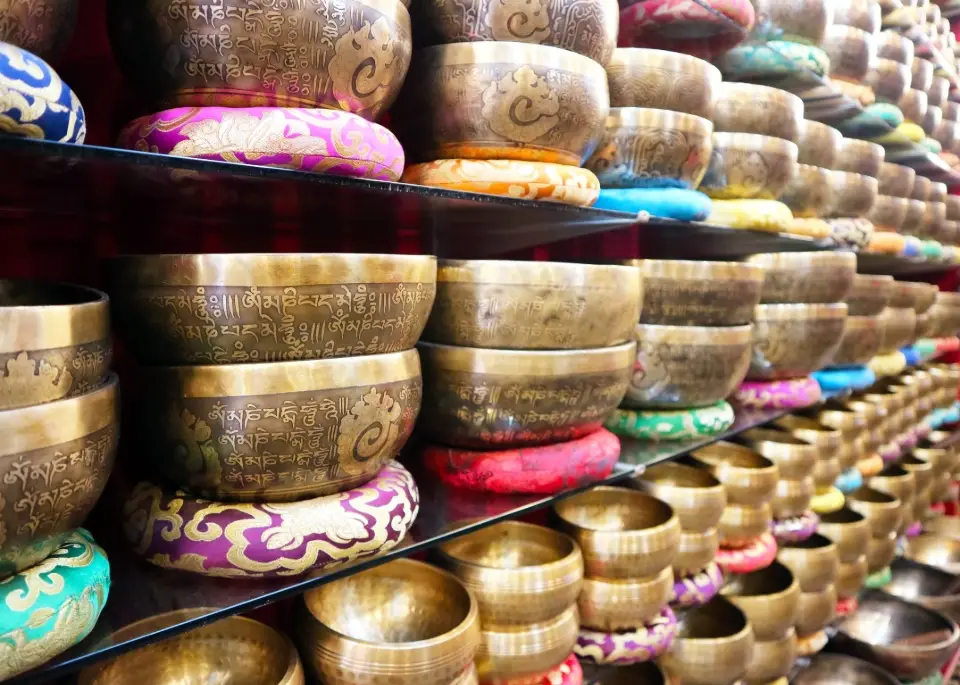
When we speak about Tibetan singing bowls, we often imagine ancient monasteries, monks, and millennia-old rituals. The truth, however, is more down-to-earth, more colourful, and far more interesting. Most of the bowls we today call “Tibetan” are in fact Nepali or Indian, while authentic Tibetan bowls are rare. The term “Tibetan” itself became established relatively late and functions more as a cultural and commercial label than as an accurate geographical description.
The story begins long before the Himalayas became a spiritual symbol in the West. The shape of the bowl as a vessel is extremely ancient. Archaeological findings show that metal bowls were used as early as ancient Mesopotamia, in the region between the Tigris and Euphrates rivers, including parts of present-day Turkey. These bowls were not “singing bowls” in today’s sense, but people have long known that metal carries sound, vibration, and power. The vessels had ritual, practical, and symbolic functions, and the skills of metalworking were highly valued knowledge.
Over the centuries, trade routes connected Mesopotamia, India, Nepal, and Tibet. Knowledge of metalworking was passed on, adapted, and enriched. It was in Nepal, especially in the Kathmandu Valley, and in Northern India that the tradition of hand-hammered metal bowls developed into what we now know as singing bowls. To this day, the largest number of workshops and master craftsmen who produce bowls using traditional methods can be found there.
The manufacturing process is slow and requires patience, sensitivity, and strength. The bowl begins as a flat metal disc, most often made from an alloy known as bell metal, a combination of copper and tin. The metal is heated to a high temperature, after which the craftsman begins shaping it with rhythmic hammer blows. Heating, hammering, and cooling—this cycle is repeated many times. Each strike changes the form and the future sound. This is why no two bowls are ever exactly the same, even when made by the same master.
There is often talk about the “seven metals” in singing bowls. In the traditional narrative, these are gold, silver, mercury, copper, iron, tin, and lead, symbolically linked to the planets and to the wholeness of the human being. In reality, most authentic bowls are primarily made of a copper–tin alloy, while the other metals, if present at all, appear only in trace amounts. Here, symbolism is at least as important as the chemical composition.
Interestingly, in traditional Tibetan Buddhism, bowls were not a primary ritual instrument. Bells, vajras, horns, and mantras were used far more frequently. Singing bowls entered the spiritual and therapeutic context on a larger scale in the 20th century, especially after the 1960s and 1970s, when the West began actively seeking Eastern practices for meditation, healing, and inner balance. At that time, the term “Tibetan” became a symbol of wisdom, spirituality, and ancient knowledge—and it has remained so ever since.
Today, we can say that singing bowls are the result of cultural exchange. They carry within them the ancient history of metal, the craftsmanship traditions of Nepal and India, and the modern human pursuit of harmony and awareness. When a bowl “sings,” it does not belong to one country or one religion—it belongs to the shared human experience of sound and vibration.
Perhaps this is why their most accurate name is not “Tibetan,” but simply “singing bowls” — instruments born from fire and the hands of the craftsman, which still remind us today that sound is a bridge between body, mind, and the world.